

OEE – Overall Equipment Effectiveness for High-Performance Industries
OEE (Overall Equipment Effectiveness) is one of the most comprehensive indicators for measuring the real effectiveness of production processes.
By analysing availability, performance and quality, OEE makes it possible to identify losses, optimise resources and boost industrial competitiveness.
It is a critical parameter for organisations seeking to reduce operating costs, improve product quality and ensure deliveries within the agreed deadlines.
Measuring and monitoring OEE consistently translates into more informed decisions and sustained continuous improvement.
What OEE is and how it is calculated
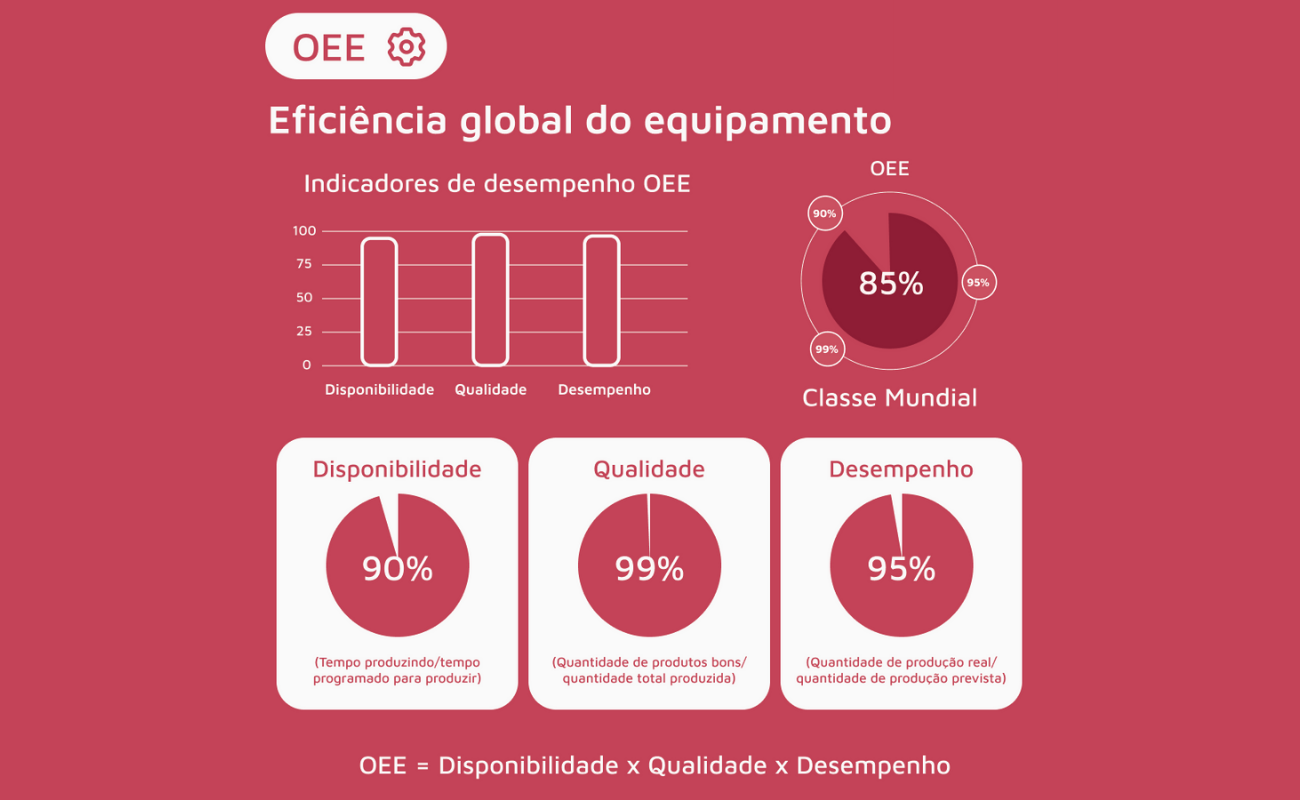
The calculation of OEE results from multiplying three factors:
Availability – the effective time during which the machine is producing, taking into account planned and unplanned stoppages.
Performance – the comparison between the actual speed and the ideal production speed.
Quality – the percentage of good units produced in relation to the total.
Practical example:
If a machine has 90% availability, 95% performance and 98% quality, its OEE will be:
OEE = 0.90 × 0.95 × 0.98 = 83.79%
This value indicates that there is scope to optimise around 16% of the production capacity.
Main benefits of monitoring OEE
Reduction of unplanned stoppages by identifying the main causes.
Increased productivity by optimising the production rate.
Improved quality by detecting defect patterns.
Optimisation of resources, both human and technical.
Decision-making based on real data, not on estimates.
Greater predictability for planning deliveries and maintenance.
OEE and continuous improvement
OEE is a fundamental tool in Lean Manufacturing and TPM (Total Productive Maintenance), enabling preventive action.
Companies that apply continuous monitoring are able to identify small losses — such as micro-stoppages, excessive setup times or speed variations — which, when accumulated, have a major impact on productivity.
Integration with MES systems
Using OEE integrated with MES (Manufacturing Execution System) systems, such as INFOS's KORA Productivity, further enhances the results.
With this integration, data collection is automatic, eliminating manual errors and providing real-time reports for managers and production teams.
This makes it possible to:
Monitor multiple production lines simultaneously
Generate immediate alerts for anomalies
Compare performance between shifts, machines or manufacturing units
Define corrective actions based on evidence
Practical application cases
Textile and Clothing Sector:
OEE helps to identify bottlenecks in cutting or weaving machines, reducing downtime and raw material waste.
Processing Industry:
It allows the efficiency of plastic injection lines, moulds and metalworking processes to be monitored, optimising the production cycle.
Food Industry:
It monitors critical equipment to ensure quality standards and meet strict delivery deadlines.
Implementing OEE with INFOS
INFOS develops and implements OEE monitoring solutions tailored to the reality of each client, integrated with ERP and MES.
We combine cutting-edge technology, specialised consultancy and industrial experience to guarantee measurable gains in efficiency, quality and profitability.
Contact us and discover how OEE can transform your company's productivity and competitiveness.