
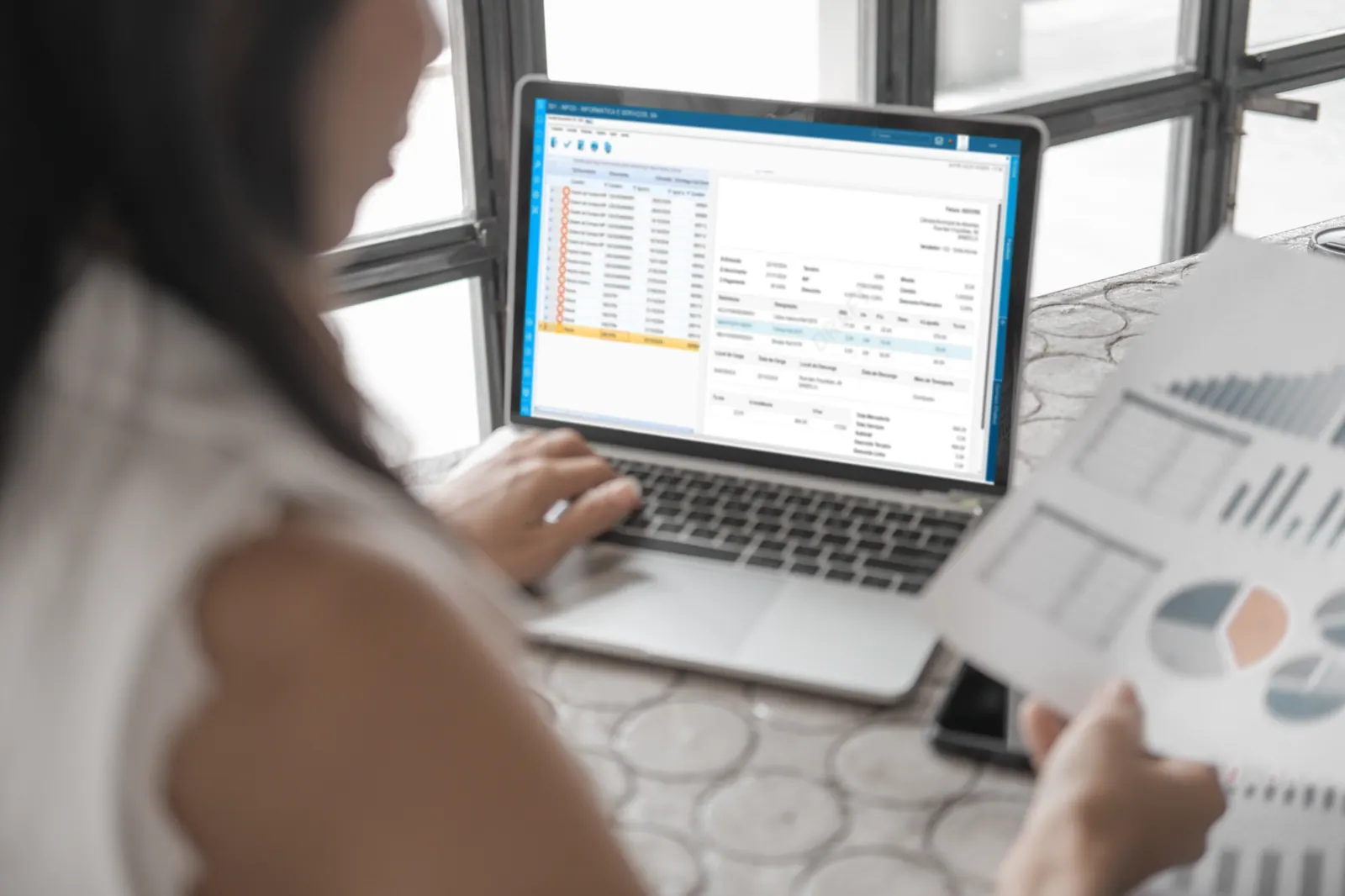
MULTI ERP 
Modular ERP with 5 specialised verticals.
An integrating suite for financial, HR, operations and production management, with vertical solutions dedicated to Textiles, Apparel, Footwear, Distribution and the Metal & Plastics industry. 36 years evolving side by side with Portuguese industry.
What it is,
in context.
The MULTI ERP has been INFOS's operational core since the company's very first year. Three and a half decades operating in textiles, apparel, footwear and distribution have turned it into a system that knows each vertical by heart — the costing of a single piece, the attribute by colour and batch, the multi-company group consolidation, Portuguese tax authority certification.
It is not a generic ERP bent to fit a sector; it is an ERP that grew up inside the sector. When a growing company needs to integrate finance, sales, production and warehouse in a single platform that speaks Portuguese, that complies with SAF-T, and that withstands audits from international customers without exceptions, MULTI is what they turn to.
Customers stay with us for 15+ years on average — for many, MULTI is the quiet foundation on which they built their digital operation.
Features
your team
will feel.
-
 spinning, weaving, dyeing, printing, making-up
 -
 cutting, making-up, finishing, packing, subcontracting
 -
 production, quality, shipping, subcontracting
 -
 promotions, prices, margins, multi-warehouse
 -
 product engineering, cost simulation, production control
 - 06Shared ERP core: finance, HR, operations, production
- 07Multi-company, multi-currency, multi-country consolidation
- 08Full batch-by-batch traceability
What lies beneath.
Architectural and technical decisions that set MULTI ERP apart from a generic product in the category.
01Five specialised verticals, one shared core
Five specialised verticals, one shared core
To answer the needs of specific sectors, INFOS developed 5 vertical solutions that integrate with the base ERP. **MULTI Textiles** — management of spinning, weaving, dyeing/finishing (yarn and fabric), printing, making-up, packing and shipping. **MULTI Apparel** and **MULTI Footwear** — production management (cutting, making-up, finishing, packing), subcontracting management, quality control and shipping. **MULTI Distribution** — control of business processes, promotions management, price setting and margin calculation. **MULTI Industry (Metal & Plastics)** — product engineering, cost simulation, production launch, production control and quality control.
02Modular, not monolithic, architecture
Modular, not monolithic, architecture
MULTI is structured in modules that activate in step with the customer's maturity. A company can start with the financial and commercial core — accounting, treasury, purchasing, sales, stock — and progressively activate production, quality control, subcontractor integration and batch-level traceability. Each module shares the same data engine, eliminating duplication and manual reconciliation. The practical outcome: the company pays for and adopts only what it needs now, but the bridge to advanced capabilities is already designed.
03Batch-by-batch traceability from raw material
Batch-by-batch traceability from raw material
In sectors where the customer asks 'which batch is this piece from?' — fashion, home textiles, footwear exported to chains with traceability requirements — MULTI keeps the full genealogy from raw material to final shipment. Audits that once took days now produce reports in minutes. Recalls are surgical rather than a patchwork.
04Multi-company and multi-currency consolidation
Multi-company and multi-currency consolidation
Portuguese industrial groups with multiple companies or international subsidiaries need to consolidate accounts across different currencies and fiscal calendars. MULTI performs native consolidation with exchange-rate rules, elimination of intra-group transactions and audit-ready group reporting. It is not a plug-in — it has been core from the start.
05Portuguese compliance, built in from the ground up
Portuguese compliance, built in from the ground up
Software certified by the Portuguese Tax Authority, full SAF-T, electronic invoicing, QR code and ATCUD on documents, IES reporting, e-invoice submissions — all integrated. Legislative changes (and there are many in Portugal) arrive by update, without re-implementation projects.
It talks to the rest of your ecosystem.
It integrates natively with INFOS products and with market tools via open APIs.
 INFOS product
 INFOS product
 INFOS product
 Market solution
 Market solution
- Power BIMarket solution
From assessment to go-live.
Every project is different, but the arc is stable. The phases accommodate real complexity, not an ideal schedule that does not survive the first meeting.
- 01
Phase 1 · Assessment
Structured interviews with operations, finance, purchasing and production. Reading of real processes, identification of bottlenecks and mapping of existing integrations. Delivery of a detailed functional survey.
- 02
Phase 2 · Design
Solution design with the customer's team. Configuration of the chart of accounts, product structures, costing rules and workflows. A data migration plan validated before any configuration.
- 03
Phase 3 · Implementation
Phased configuration, integrations with existing systems and banks, training by role (accountant, sales, operator, director), acceptance testing and a controlled pilot before full roll-out.
- 04
Phase 4 · Support
8×5 or 24×7 support, quarterly reviews, functional evolution in step with regulatory changes (SAF-T, IES, tax bulletins) and module extension as the company grows.
For those who
like the detail.
Information for IT, compliance and procurement teams. If you need further detail, the INFOS pre-sales team replies within 24h.
- Client-server or cloud architecture (AWS, Azure, INFOSCloud)
- SQL Server or Oracle database
- Tax Authority certification for electronic invoicing
- Full SAF-T (PT), ATCUD and QR Code on documents
- REST API for external integrations
- SSO with Microsoft Entra ID / Active Directory
- GDPR and ISO 27001 compliant
- Portuguese-language support from Leça da Palmeira
The most common questions
about MULTI ERP.
Answers distilled from hundreds of implementations. Missing one? Ask us directly.
How long until it goes live?
A typical MULTI implementation takes 3 to 9 months depending on the size of the company, the number of active modules and the quality of the starting data. INFOS works in phases, so the customer starts using the critical modules before everything is active.Does MULTI run on own infrastructure or in the cloud?
Both. MULTI runs on the customer's infrastructure or on INFOSCloud. For customers modernising, there is MULTI Connect — the new version with open APIs, refreshed UX and applied AI capabilities.Does it integrate with non-INFOS solutions?
Yes. MULTI has open APIs and connectors built for existing ERPs, banks, time-clock systems and external BI tools. The INFOS integration team handles the mapping during the design phase.How does it handle multi-company and multi-currency?
Natively. Multi-company and multi-currency consolidation have been at MULTI's core from the start — it was designed for Portuguese industrial groups with an international presence.Which modules can I activate later?
Financial Management, HR, Purchasing, Stock, Sales, Production, Warehouses and Mobility. The KORA, pplPortal, Subcontractors' Portal and MyBusiness-ITV modules integrate alongside.
Other products in the same layer.
The financial, commercial and operational core. Where orders are invoiced, stock is managed, production is planned and the store is run.
Let's talk.
We'll come back within 24h with next steps.
No complicated forms. One email or call, a team that knows your sector, and a concrete path forward — whether MULTI, MAXIRETAIL, KORA, PPLPORTAL or infrastructure.